


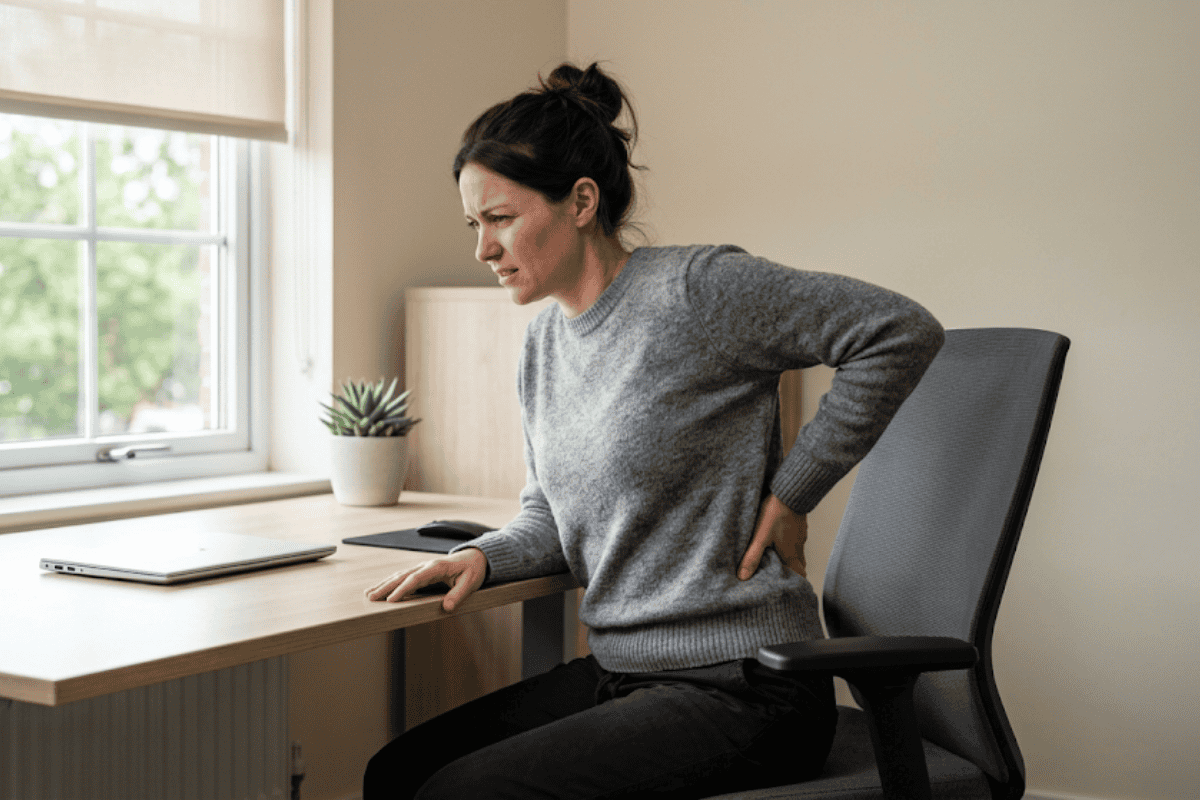
03 Sep Why Does Sitting Too Long Make My Leg Pain Worse?
Commuters driving Highway 51 or the Creek Turnpike into Broken Arrow, and anyone sitting through a full workday at a desk, are among the patients who most often describe leg pain that builds the longer they stay seated, and the sciatic nerve is usually the reason why. Understanding why sitting too long makes leg pain worse comes down to what sitting does to the lower spine and the nerve that runs from it down the leg, and once that mechanism is clear, the fixes make a lot more sense.
What sitting actually does to the sciatic nerve
Cleveland Clinic lists prolonged sitting as a specific risk factor for sciatica and recommends attention to posture as part of managing it. Sciatica itself is not a condition on its own, it is a symptom of something compressing the sciatic nerve, and MedlinePlus, the National Library of Medicine’s consumer health resource, identifies the most common underlying causes as a herniated disc, spinal stenosis, or piriformis syndrome, all of which involve pressure on the nerve roots that form the sciatic nerve.
Sitting changes the shape and pressure distribution of the lower spine in a way that standing or lying down does not. OrthoInfo, from the American Academy of Orthopaedic Surgeons, explains that sciatica pain originates when a lumbar nerve root is compressed, and a seated posture, especially one that is slouched or held for hours without a break, increases the load on the lower discs exactly where that compression tends to happen. The nerve does not become newly injured every time you sit, but an already irritated nerve root has less room to tolerate that extra pressure.
Why posture changes the pain, not just the position
Johns Hopkins Medicine names poor posture and awkward positioning specifically as sources of added pressure on the sciatic nerve. This explains a pattern many patients notice: leaning forward toward a screen, sitting in a low or overly soft chair, or crossing one leg over the other for long stretches all tend to make symptoms worse faster than sitting upright with feet flat on the floor.
| Position | Effect on Sciatic Nerve | General Recommendation |
|---|---|---|
| Prolonged sitting, especially slouched | Highest pressure on lower spine and nerve roots | Limit continuous sitting; sit upright with support |
| Standing | Moderate pressure, more evenly distributed | Useful to alternate with sitting |
| Walking | Promotes movement and circulation around the nerve | Short walks every 30 to 60 minutes of sitting |
| Lying flat with knees supported | Lowest pressure on lower spine | Helpful for short-term relief during flare-ups |
The pattern in that table matches the sources above: sitting, particularly slouched sitting, puts the most pressure on the lower spine and nerve roots, while standing, walking, and supported lying positions each reduce that pressure to varying degrees.
When to stop managing it with posture alone
Mayo Clinic notes that sciatica often improves with conservative measures, but pain that keeps returning regardless of posture changes, or that comes with numbness or weakness in the leg or foot, points toward a nerve root that needs more than positional adjustments. At that point, identifying exactly which disc or level is compressing the nerve becomes the priority, since posture changes can only do so much when there is a structural cause underneath.
If changing your sitting habits and taking regular breaks has not made a real difference after a few weeks, get evaluated rather than continuing to adjust your chair setup indefinitely.
Why Choose Pain Management of Oklahoma
Sciatica from prolonged sitting gets treated as a simple posture problem more often than it should be, when for many patients the real driver is a herniated disc or narrowed nerve pathway that posture changes alone cannot fix. Pain Management of Oklahoma treats lumbar radiculopathy, the clinical term for this nerve root irritation, as one of its core conditions, using imaging to confirm exactly which level of the spine is involved before recommending an epidural steroid injection or another targeted treatment.
That level of specificity matters for anyone whose job or commute in the Broken Arrow, Sand Springs, Grove, Sallisaw, or McAlester area makes long sitting unavoidable, since the goal is not to tell a patient to stop sitting, it is to identify and treat the actual source of nerve irritation so sitting stops being the trigger in the first place.
Conclusion
Sitting too long worsens leg pain because it increases pressure on the lower spine and the nerve roots that feed into the sciatic nerve, especially when posture is slouched or held in one position for hours. Short walks, better posture, and regular position changes help many people, but pain that persists despite those changes usually points to a structural cause worth having evaluated directly.
Leg Pain Not Improving With Posture Changes? Request a free consultation to find out exactly what is compressing the nerve and what treatment will actually address it, rather than just managing around it.
Frequently Asked Questions
Can sitting too long actually cause or worsen sciatica?
Yes. Prolonged sitting, especially with poor posture, increases pressure on the lower spine and the nerve roots that form the sciatic nerve, which can worsen existing sciatica or trigger symptoms in someone already prone to nerve irritation.
What is the best sitting position if I have sciatica?
Sitting upright with your back supported, feet flat on the floor, and hips level tends to reduce pressure on the lower spine compared to slouching or leaning forward. Taking breaks to stand or walk every 30 to 60 minutes also helps.
Is it better to sit, stand, or lie down with sciatica?
None of these positions should be held for hours at a time. Alternating between sitting, standing, and short walks generally reduces sustained pressure on the sciatic nerve better than staying in any single position too long.
How long does sciatica from prolonged sitting typically take to improve?
Many cases improve within a few weeks with posture changes, movement, and reduced sitting time. Pain that persists beyond several weeks despite these changes usually warrants a professional evaluation.
How does posture affect the sciatic nerve during sitting?
Slouched or forward-leaning posture increases pressure on the lower spinal discs and nerve roots, while upright, supported posture distributes that pressure more evenly and reduces irritation of the sciatic nerve.

Sorry, the comment form is closed at this time.